Resources & Assessments
How we teach, what we provide, and how trainees are assessed throughout the course.

How we teach
During the face-to-face training days a variety of teaching methods are used, including:
- Presentation with follow-up discussion for many of the theoretical aspects of the course.
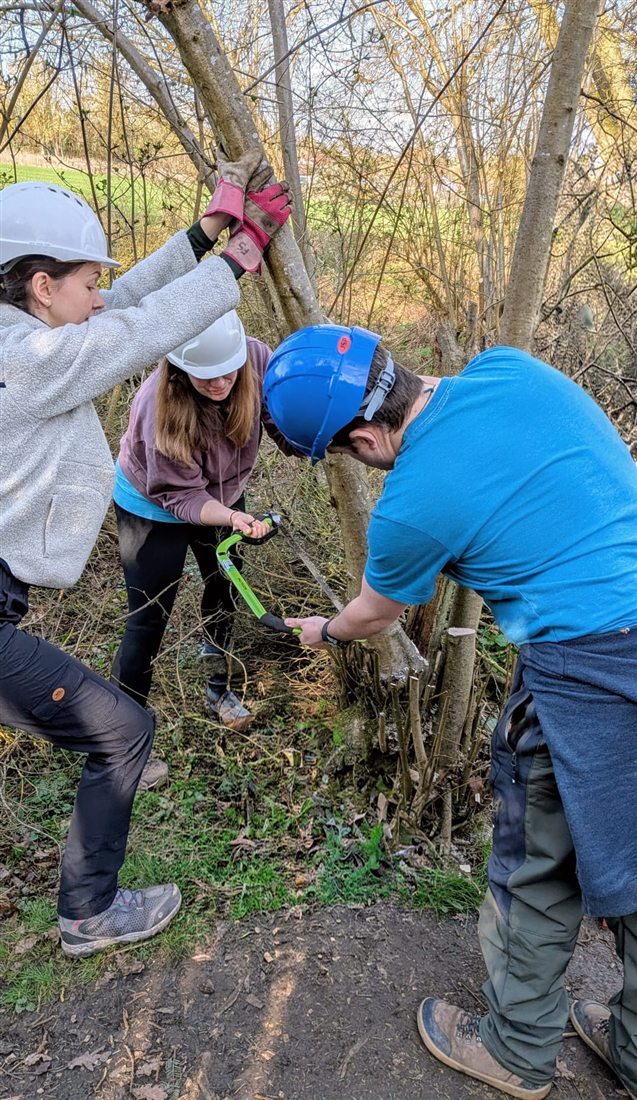
- Instruction and demonstration with opportunities to practice for many of the practical, skills-based elements of the course.
Resources
During the face-to-face training days we provide all the necessary tools and safety equipment for use by trainees — appropriate and in good working condition. Trainees need to come with a pair of sturdy boots (ideally safety boots), outdoor clothing (including waterproofs) and a camera (optional but recommended).
We provide a journal, a course file and reference material or sources for all the theoretical topics covered. We also provide a library for learners to access during the face-to-face sessions.
Assessments and coursework portfolio
The assessments which take place during the training:
- Tutor observations during face-to-face training days.
- Interim assignments (normally four written assignments completed between the initial training days and practical skills days).
- Practical Skills and Peer Assessment during the practical skills days.
- Observation of trainees delivering one of the six sessions of their ‘Introduction to Forest School’ programme (the Mentoring Visit).
- Coursework Portfolio.
Trainees complete a coursework portfolio containing evidence for the five units, including a number of written assignments and a site- and group-specific handbook of policies and procedures. Feedback from the interim assignments, a personal tutorial during the practical skills assessment days, and portfolio tutorials and workshops all support trainees with the writing of assignments. Further support is available via email.
First aid
Before you can qualify as a Level 3 Forest School Leader you must also hold a relevant Outdoor/Forest School First Aid (OFA) qualification. This is a 2-day course which equips you with skills and strategies to care for the infants, children and adults involved in indoor and outdoor activities (a standard 1-day Paediatric First Aid or First Aid at Work certificate is not sufficient). If you do not have this qualification, you can complete it as part of the course (for £100) or book independently (most providers charge around £160).
Outdoor food safety
It is good practice for Forest School Leaders to gain the knowledge and understanding of food hygiene and skills in safe handling and cooking, to enable them to safely cater at Forest School for individuals and groups. During the Practical Skills Assessment Days, trainees learn how to keep food and groups safe and how to comply with the legal requirements in an outdoor setting where there may be no access to running water, refrigeration, or the facilities associated with a catering kitchen. Charlotte is a qualified assessor for the Level 2 Outdoor Food Safety qualification and assesses trainees both practically and through a short written test, enabling them to gain a Level 2 Certificate accredited by ITC First.
Mentoring visit
Whilst you are running your 6-week ‘Introduction to Forest School’ programme, one of your tutors will visit you at your site to provide mentoring support and guidance. They will observe a session and provide written feedback relating to safety, leadership and your application of the Forest School ethos and principles. An additional charge of £75.00 plus 45p per mile is levied for participants working outside a 50-mile radius of the training venue.